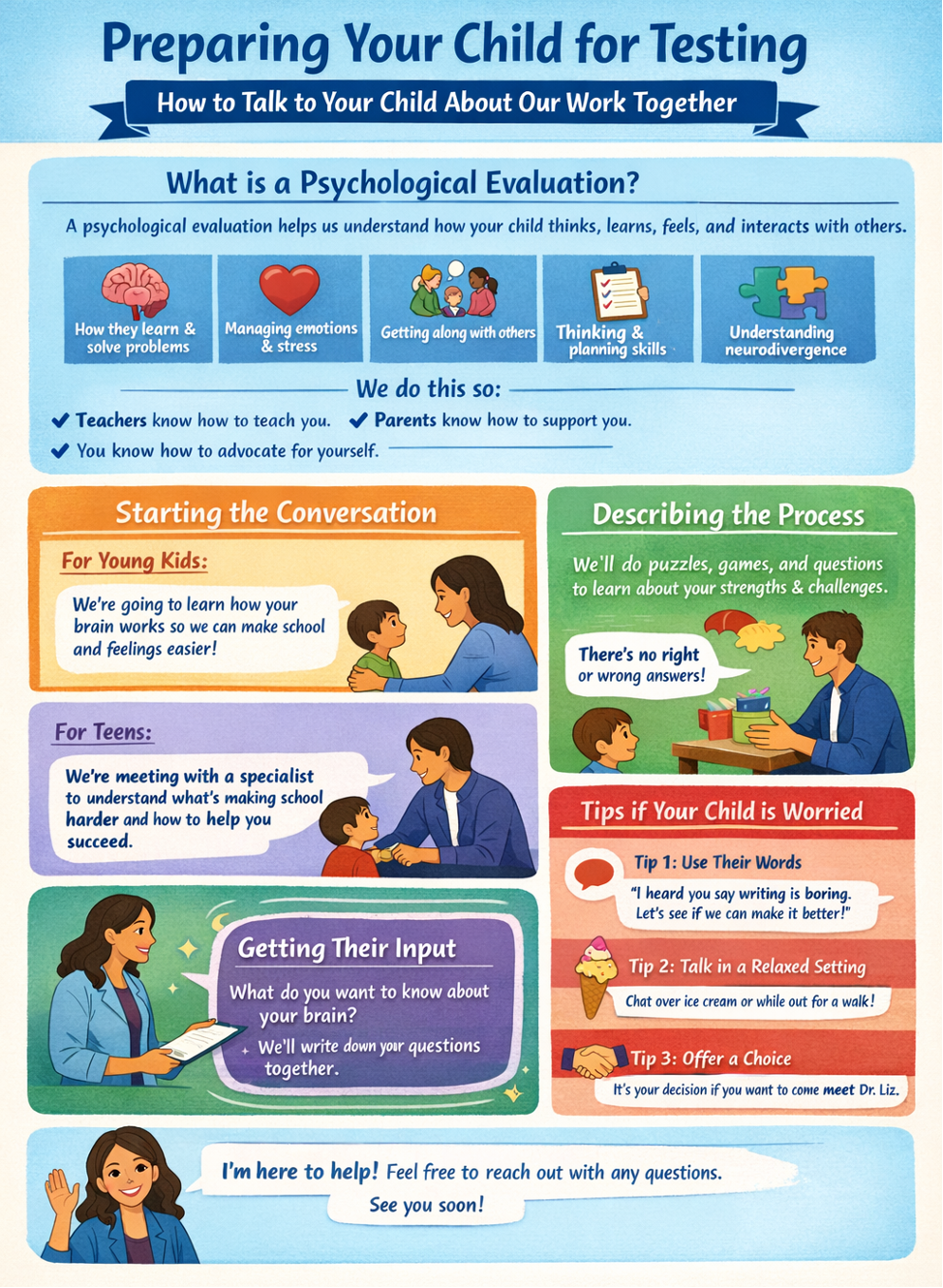
Preparing Your Child For Testing
How to talk to your child about our work together
We are looking forward to working with your family! Here are some ways to introduce the process to your child, whether they are young or older.
What is a Psychological Evaluation?
A psychological evaluation helps us understand how your child thinks, learns, feels, and interacts with others. We look at many areas, including:
How your child learns and solves problems
How they manage emotions and stress
How they get along with family, friends, and classmates
How they organize, plan, and remember things (executive functioning)
How their ways of thinking (including neurodivergence, if relevant) can be understood and supported
We do this so that:
Teachers know how to teach you
Parents know how to support you
You know how to advocate for yourself
Starting the Conversation
For young children:
You might say, “I’ve noticed you’re working really hard at ___ this year, but it still seems pretty tough, and I’m not sure why. I think if we learn more about how your brain works, your teachers and I can help you even more. We met with someone who helps kids and families figure out how to make school and learning easier (or understanding big feelings, making friends, etc.).”
For older children or teens:
Try, “I know school has been challenging in some ways this year. I want to make sure we understand what’s making things harder, and how you learn best. We’re meeting with a specialist who works with kids your age to figure out what can help both at school and at home.”
Describing the Process
When your child comes in, they’ll participate in a variety of activities. These might include puzzles, games, answering questions, and talking about things they enjoy, things they find challenging, and how they feel. The purpose is to learn about your child’s strengths and challenges—not just at school, but also with friends, feelings, and everyday life. There are no right or wrong answers, and your child is not in trouble or sick; this is simply a way to help everyone understand them better.
For young children:
It’s important to let them know this isn’t a visit to the doctor—no one is sick, and there are no shots or medical procedures. We’re just learning about how their brain works and what makes them unique.
For older children and teens:
Let them know this is a confidential process focused on finding solutions that work for them. Their thoughts and input are extremely important in figuring out what will be most helpful.
How you might explain it to your child:
“The psychologist will do different activities with you to figure out how you learn and think, what your strengths are, and why some things might feel harder right now. Some activities will be fun, some will be easy, and some might be a bit challenging. Your job is just to try your best, and if something is tricky, let the psychologist know so you can work together to understand why.”
Remind your child that sometimes the psychologist may ask a lot of questions, and it’s perfectly okay if they don’t always know the answer.
Getting Their Input
Your child is encouraged to ask their own assessment questions. This not only helps me know what is important to them, but gets them more invested in the process itself.
Kids may need a little time to mull it over and get their thoughts together, so don’t be afraid to ask a few times. This may sound something like:
“There are things I’d like to know to help me support you better, but I’m wondering what you’d like to know about your brain? If you can’t think of anything right now, that’s ok. I’ll ask you again later and we can try to write down a list together. That will make sure that the work you do with the psychologist is as helpful to you as possible."
What if my child doesn’t want to be assessed?
If you are worried your child will resist coming in for an assessment, you are not alone! Here are some tips for setting it up for success.
Tips:
Tip #1: Use your child’s words to describe the problem
Many children resist testing because it feels like adults don’t get it. For this reason, it can be helpful to think about how your child is describing the problem.
For example, instead of “writing is hard,” they may say, “writing is boring” or “my teacher is unfair.”
By using their language, you are assuring them that we will help them solve their problem, not just ours. This might sound like:
I’ve noticed that you really don’t like your math teacher this year. I’m wondering if there’s a way we could make that class better for you.
I’ve noticed that we are in a bad nagging cycle around homework. I know you don’t like it and I don’t like it either. I wonder if there’s a way we can break out of it.
I’ve noticed you’re getting in trouble a lot this year and it doesn’t seem to make sense. I wonder if there’s a way we can figure it out together.
I heard you say that you hate school, and I can totally see why! Let’s see if there’s a way to change that.
Tip #2: Talk over ice cream or another activity
Some children may be worried they’ve done something wrong, or that there is something wrong with them. For this reason, I recommend talking to your child in a place where it is obvious that there is nothing wrong and they are not in trouble. Having a bowl of ice cream, taking the dog for a walk, or playing catch are all good ways to have a conversation without it feeling too “serious”.
Tip #3: Let them know it’s not mandatory
If your child is having a really hard time, we will work together to figure it out. The first step is letting them know it’s not mandatory. Keep in mind that we can get a lot of information about what might help your child in other ways, and if your child is resisting, the actual tests we do are unlikely to be valid.
Besides, giving a child the choice often makes them more likely to participate because it:
Shows them respect and establishes trust
Gives them choice and control over the situation
Allows them to express their concerns
Gives adults a chance to address those concerns before testing begins
Your child is welcome to come in for a “non-committal” first session just to check me out. While 99% of the time we end up moving forward, if for some reason we are not able to at this time, we have established a relationship so that your child can come back when they are ready.
This may sound like:
It makes sense that you do not want to do the testing. I imagine I would be skeptical as well! I will respect your decision if you decide you really do not want to do it, but I want to make sure you have all the information before you make your final decision. Would you be willing to meet with Dr. Liz once just to see what it’s all about?
While your child may not agree on the problem that brought you in as a parent, we can often find something the child does want to work on, and that gives us a way to move forward.
See you soon!
Please let me know if you have any additional questions or concerns. I’m excited to start our work together and learn more about your child’s amazing brain!